Prime Minister Koizumi failed trying to pass his Postal Service reform bill. As a consequence, he dissolved the lower house and called for snap elections. They're next week.
What does this mean? It means that every day I am annoyed by any number of politians driving around screaming their good points from loudspeakers.
There's one driving through my neighborhood right now. This woman has taken the distinctive call of the Yaki Imo man and insterted her own name. It is echoing off of the mountains behind my house. If I could vote, I wouldn't vote for Takeda Saoru.
Monday, September 05, 2005

Midnight Snack
It’s so humid right now, at 2am in the morning as I write my research paper, that the crispy graham cracker I unwrapped from its package a mere five minutes ago has become a tender, flexible morsel falling apart in my hand.
Sunday, September 04, 2005
Getting Out of Hand
I was watching some American TV last night on cable. There was this scene where a guy was working late at night, and a woman came in to see what he was doing, and he offered her a few slices of pizza. She said no.
I almost cried. I could just taste the pizza in my mouth. How could you reject the cheesy greasy goodness of that pizza? If you don't want it, give it to me!!
See what a year in a cheese deprived country will do to you? Begging food from the television.
I almost cried. I could just taste the pizza in my mouth. How could you reject the cheesy greasy goodness of that pizza? If you don't want it, give it to me!!
See what a year in a cheese deprived country will do to you? Begging food from the television.
Unable to Process your Request
I've been getting quite a few requests for things to be brought back from Japan. This is great because I love to bring things back for people and it makes it so much easier when they tell me just what they want. The problem is "just what they want" has fallen into horribly vague categories.
For example, "I really liked the rice snacks you sent me once." Rice snacks being the operative description for 85% of all snacks produced and eaten in Japan. Senbei, rice crackers with seaweed, with sesame, seasoned, unseasoned, shaped like bugles, circular, spicy, shrimp-flavored, soup flavored, mixed with dried beans, mixed with little dried fish, go well with beer, taste good on a long train ride...Is it that they are so mysterious that a detailed explanation is impossible? Or am I asking too much of my non-Japanese reading friends?
I am more than happy to bring things back for whoever asks, in fact, the more I think about it, the more I realize that half of my luggage will probably end up being gifts for people. So please, request as much as you like. Just be aware that if you can't give me the name, the shape, and the color of the packaging, you may not be getting exactly what you asked for.
Thursday, September 01, 2005
Dinner and a Motivation
It's always a toss up whether I am going to enjoy myself or be bored out of my mind when I go visit my advisor emeritus. Today, being the last time that I would be meeting her this year, was no exception.
We started out at her house where she apologized profusely for the fact that she had not conveyed to me all the knowledge she had stored inside her brain. She then attempted to transmit a bit of it, but it only served to remind me of the fact that I know absolutely nothing, comparitively speaking, and the path to scholar-dom is a long and tortuous one. It was at that point that I felt I had absolutely decided that studying in Japan was a lost cause and I should just go back to the States and find some sort of random job.
Then we took a little wander down to Uji where I was treated to my second kaiseki ryori (multiple course Japanese style dinner) meal of the year. I can't even remember all of the dishes, but I do remember my favorite. It was the one I expected to like the least: salted and grilled ayu fish dipped in a green sauce made from leaves. The only part of the fish I did not eat was the head; the rest of it was delicious, especially the tail.
Anyway, my advisor asked me my plans for after the Fulbright ended, and I casually mentioned that I was looking to go to grad school in Japan, and would she be able to recommend any professors? Oh hoh. That got the ball rolling - she's looking into the best places for me to go and she'll give me a call next week.
It's not that I can't do these things for myself. It's just that I have zero connections and getting connections is like pulling teeth. My advisor, however, has been around quite awhile. She has been blessed by the Pope, recieved 3rd century Buddha statues as gifts, her house has enough books to become a freestanding library. She has connections. And with any luck, these connections will be handed to me and I shall have an easier time mucking through the bureaucracy that is the Japanese educational system. I have been rejuvinated.
Tuesday, August 30, 2005
Midori
 Kokedera, "Moss Temple," is the nickname for Saihoji, a small Zen temple in western Kyoto. As its nickname implies, it is famous for moss. It is so famous, in fact, that you have to apply weeks in advance to get in and pay the incredible amount of 3000 yen (~$30).
I had heard great things about this temple from friends and teachers. I had heard that not only do you get to tour the magnificent moss gardens, but you also get to copy sutras. In fact, I heard you were Required to copy sutras. Sounded like fun to me, so I went.
Disappointment #1: We didn't copy sutras. We did write our names and our "Negai goto" (thing we wish for) on a "gomaki" (a stick of wood for writing wishes and names on that will later be burned in a ceremony to release your wishes to the heavens where they can be answered), but I was really hoping for some sutra writing. At least we got to participate in sutra chanting.
Disappointment #2: The moss was a little dry. I guess I was expecting the sort of moss I had seen at Ginkakuji earlier in the year right after the rains. Plants that survive on humidity lose their luster during the dry summer, I know, but I was hoping for a little more green. Not that there was a lack of moss; according to the guide, there are over 150 different kinds of it in the garden.
Disappointment #3: It started to rain on our way into Matsuo Shrine, so we didn't get to wander around, and I didn't get time to try to remember the things I had read about it.
The day was not all disappointing, however. I got to go to a section of Kyoto I rarely see, and it had been awhile since I'd made a temple visit. It was a nice break from the studying.
Monday, August 29, 2005
Counting Down
In 15 days I will be in the United States.
In 15 days I will be eating pizza, steak, cheese, cake, cheesecake, Life cereal, oatmeal, hummus, honey roasted turkey lunchmeat, tacos, burritos, apples, granola bars, hamburgers, hotdogs, and so much more.
In 15 days I will begin a month and a half vacation encompassing friends, family, greyhound buses, Boston, Kentucky, Ohio, Indiana, an alma mater, professors, and driving on the right side of the road.
In 15 days I'll be marveling at the height and girth of Americans, the size of servings, the inconvenience of public transportation, the lack of chopsticks, and my inablity to say "Thank you" in English.
In 15 days I'll be on my way to see you. Tell me when's a good time, or I will be dropping in unexpectedly.
Saturday, August 27, 2005
Welcome, welcome
I'm continuously surprised by my house. Or, rather, by the living creatures that visit my house.
Today, as I was watching the news, a weasel casually strutted across my back porch.
Now, I do not live in the countryside. The neighbor's house is a mere six inches from mine. So I believe I am justified in thinking that wildlife has no place on my street. However, here I am with geckos in my room and weasels on my porch.
I'm just waiting for the wild monkeys to come down the mountain to take up residence in my kitchen.
Wednesday, August 24, 2005
Holiday Weather
I guess it's the fact that the Japanese have lived on this island for a good couple of thousand years that makes them so incredibly accurate at predicting weather patterns. My koto teacher said to me the other day, "Once O-Bon is over the temperature will drop and the nights become cooler."
O-Bon was over three days ago. The day after O-Bon the temperature was three degrees cooler. Yesterday was six degrees cooler than last week. Last night I had to get up in the middle of the night to get a blanket.
I just don't understand how Japanese holidays control the weather.
O-Bon was over three days ago. The day after O-Bon the temperature was three degrees cooler. Yesterday was six degrees cooler than last week. Last night I had to get up in the middle of the night to get a blanket.
I just don't understand how Japanese holidays control the weather.
Sunday, August 21, 2005
From Fear to Food
When I was a child I dreaded swimming in an ocean or lake with seaweed. If there were slimy plants around that could potentially brush up against my leg, I wanted no part of it.
But there must be something about living in a country that values seaweed as a food product that has changed my perception.
I'm swimming in the ocean, and a large piece of seaweed floats by. I reach out and grab it.
"Wakame!"
"It looks so tasty."
"It's like we're in a giant bowl of miso soup."
"We should dry it out and take it back as a gift."
"If we're floating in miso soup, I'm the tofu: bright white!"
"Are you getting hungry?"
P.S. As I write this, I am munching on pieces of dried Korean seaweed. So delicious!
"My Boom"
The Japanese have lately come to love using the english word "my" as a fuzzy little adjective that really means something more like "personal or individual." You can buy a "My Car," or a "My House." At frisbee I'm often asked if I brought my "My Disc." But the most overused of this construction is "My Boom." What are you into lately?
Lately, "My Boom" is dancing. And so when my old host family took me to their little neighborhood festival and everyone was doing the O-Bon Odori (O-bon dance). I thought it would be fun to join in.
The tradition of an O-bon Odori goes way back to when the dances were performed as part of the sending away ceremony for the spirits visiting during O-bon. It has been passed down for hundreds of years and is still performed around O-bon by small neighborhoods, although without the context of a religious rite.
The dance is fairly simple. Everyone joins together in a circle and the dance proceeds counterclockwise around and around. The little old ladies taught me the steps and hand gestures using a little song that matches the action. I asked my host father whether the song had anything to do with the meaning of the dance, and this is what he explained.
"The words that describe the actions are actually describing a coal miner's work: Dig it up, dig it up. Throw the sack on your back. Wipe the sweat off your forehead. Push the cart. Sweep it clean." Neither he nor my host mother knew how that explanation came to be used.
Anyway, I learned the dance, and after three or four turns I was dragged up to the platform where everyone could watch the foreigner doing the traditional Japanese dance. My host family is convinced that a picture of me will be in the little neighborhood newspaper next week.
Saturday, August 20, 2005
S-P-E-L-L-I-N-G
The Japanese language borrows quite a few words from foreign languages. However, you can't just walk up to someone and say a word and think they'll understand you. Chances are, they might know the word, but you aren't pronouncing it correctly. You must Japanize it. Here's an example from the bar I went to last night.
Barkeep (in japanese): What would you like to drink?
Me: I'll have a White Russian.
B: A what?
M: Wahito rahshian?
B: (blank look)
M: Wahitoh rashion? Wahito rishon? Rishian? Rushan?
B: Oh!! Wahitoh rushion!!
Sometimes I don't understand how a one syllable mistake can make me totally incomprehensable. Try, try again.
Thursday, August 18, 2005
Not A Day Goes By
1. I went to the beach down in Kobe today. It was wonderful. The Japanese lifeguards, I mean "Surf Patrol," were wearing speedos and those little tri-colored hats with the whirl-gigs on top, only without the whirlygigs. There will be pictures later.
2. I got back to find a visitor waiting in my room. I gecko had come to visit. It does not bother me that there was a gecko in my room. It bothers me that he was able to get in here.
3. Leslie sent me a very sobering email. The world has lost one of it's greatest proponents for peace, especially peace among religions. Brother Roger, the founder of Taize, an ecumencial Christian community in rural France founded to promote dialogue and understanding, was stabbed to death while attending evening prayer service. Read about it here.
I have been to Taize twice and met with Brother Roger both times. I cannot express how how disturbing it is that this quiet old man who commanded such a presence and yet brought such a sense of peace could be murdered. I am just glad that his last moments were in the church he built surrounded by the people who loved him.
Wednesday, August 17, 2005
The Mountains Are On Fire

In the middle of August there is a nationwide unofficial national holiday week called O-bon. O-bon is an old Buddhist festival marking the one time a year when the spirits of the dead return to this world to check up on their relatives. The focal point of this tradition is the graves; families return to the countryside to meet up with relatives and visit family graves together. They clean the area, offer flowers and food, and pray for the souls of their ancesters and the safety of their families.
One of the major concerns of the living is that the spirits of the dead will get lost on their way too or from their resting place on this earth. There are many ways of guiding the spirits to your home, but the most important activity is the one to send them back to the other world. There are many festivals involving lanterns set adrift in rivers, lakes, or oceans.
One of the most memorable of the traditions in Kyoto is the "Go-zan Yamayaki," the "Burning of the Five Mountains." There are five mountains surrounding Kyoto onto which five characters have been traced out in fire pits. Once a year, on the 16th of August, the last day of O-bon, all five are lit simultaneously. The characters are:
Dai = big (east)
Hou = law
Myo = mystery, or skill
Fune = boat (not actually a character. it's a picture of a boat)
Dai = big (west)
I am lucky enough to live in a place where I could see four of the five at the same time. Unfortunately, the fifth one went out before I could get to a place to see it.
Sunday, August 14, 2005
Dick and Jane Go A-Hunting
I remember reading picture books when I was little where the story involved kids trying to catch butterflies with nets. I think I even saw that sort of thing in old movies. But I can't remember one instance of me or anyone I know grabbing their butterfly net and a lunch pail and going butterfly hunting. Our hands were good enough for whatever insect we wanted to snag.
It seems to me, that when it comes to bug catching, Japanese children live in the Dick and Jane world of butterfly nets and bug cages. Wherever you go during summer vacation you are bound to see at least three kids prowling for insects, their nets at the ready.
Maybe the difference lies in the type of bugs they are catching. My favorites were always lightning bugs, rolly polly bugs, and caterpillars, but in Japan they're aiming for the big stuff: cicadas. I am told that cicadas do not annoy all parts of the United States with their buzzing/humming, but we had them in Indiana. They were elusive creatures, never seen, only heard. The only way you could tell they truly existed was by the shells of skin they left on the trees for you to find in the morning.
But in Japan, they are not only an ever-present hum outside your house, cicadas are also small torpedoes to be avoided when riding your bike, walking your dog, or merely checking your mailbox. And so, the children arm themselves with nets and strong cages, competing as to who can snag the most.
A child was telling his father in the park this morning, "I'm gonna get ten!!" And I could believe it, for in fifteen minutes he had already collected four.
Saturday, August 13, 2005
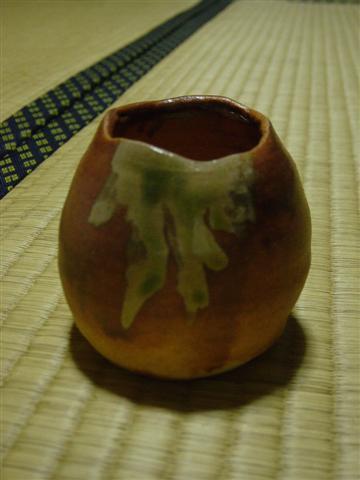
If all else fails, I have a backup dream job


Wednesday, August 10, 2005
Welcome To My Neighborhood
I have never actually met any of my neighbors. We do the mutual "acknowledgment of existence" head nod if we see each other on the street, but there is rarely a "hello" that passes between us.
Despite this fact, I feel like I know my neighborhood pretty well. I know that the old woman next door gets up at 5:30am. She talks to her dog when she lets him out at 5:45a. I know that the garbage man is always two hours late, and the recycle man is thirty minutes early. I've recently come to realize that the man next door comes home every night at 11:30pm because I can hear the sliding doors on his van. And either the people across the street are very good about beating their dog every evening at 11pm, or that's when they put him in his kennel and he howls in protest.
Living in a such close proximity to people in houses where the walls are paper thin can make one either appreciate privacy or develop an addiction to gossip.
Tuesday, August 09, 2005
The Benefits of Old Age
The stationmaster is shouting politely on his blowhorn: "There are little children and elderly persons present. Please do not push or shove. Please wait patiently."
I am immediately elbowed out of the way by a 4'5" grey-haired grandma with two grandchildren in tow.
I am immediately elbowed out of the way by a 4'5" grey-haired grandma with two grandchildren in tow.
Hanabi Overtime
Yesterday there was a big fireworks show on Lake Biwa. Tomorrow there's one in Uji. This weekend there are a few scattered around Kansai, and next week there will be more. We have officially entered Hanabi Season.
As if there weren't enough national holidays and festivals, the Japanese adopted August as the unofficial month to celebrate summer - with massive amounts of fireworks. In many ways the shows are just like the more traditional festivals: families and friends get together, the girls wear yukata, and everyone lines up for snow cones and meat on a stick at the food stalls. The only difference is that instead of mikoshi, everyone stands ooing and ahhing at the very impressive bursts of fire exploding in the sky.
Last night's show at Lake Biwa was the most amazing fireworks display I have ever seen. It lasted a full hour. But even more impressive was the crowd control that quickly and efficiently shuffled thousands of people onto trains without extreme instances of shoving, screaming, or groping among the masses.
Monday, August 08, 2005
Where the streets have no names
I was just thinking about my address and I realized something that I hadn't noticed before. Most of the streets in Kyoto have no names. Of course the large streets do, 3rd St, 4th St, Kitaoji. But as soon as you turn off of those roads into the neighborhoods, you enter a land where the streets do not have names.
How do people have addresses then? The Prefecture is divided into Cities. The Cities are divided into Wards. The Wards are divided into Areas. The Areas are divided into Towns, and your house has a number. Sometimes in the downtown areas where there are more roads with names, the placement of your house could be described like in Ohio: on road A, just a little past road X.
All of this, however, makes driving directions a little difficult. When I tell people how to get to my house it involves lots of landmarks and counting of intersections. Of course, this is also why most vehicles in Japan have Navigation programs.
In any case, don't ask me how to get to my house. My number one landmark just went out of business.
Sunday, August 07, 2005
The Smell of Summer
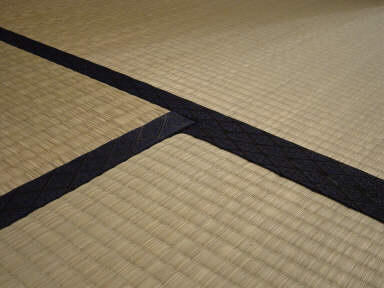 I love the smell of freshly mown grass. To me, it is the smell of summer. Unfortunately, no one owns a yard in Kyoto. And so, summer in Japan becomes another of those seasons that doesn't seem quite right. Winter has no snow, and summer has no mown grass.
The closest I can come to the smell of summer and the feel of something plant-like under my feet is tatami. Walking into a room with new tatami is like stepping out of your car into haying season. The distinctive fragrance of fresh tatami is overpowering to the point that some people can't be in the room too long with it, but at the same time it conveys a sense of the outdoors that one doesn't usually find in the city. The ban on slippers on tatami also means that inhabitants and visitors usually pad around in their barefeet, getting just a taste of what it's like to run around the front yard with your shoes off.
I am particularly grateful for my tatami room. Although it is too old to smell new, the woven straw still reminds me of my grandfather's hay mow. And whenever I walk across it, I feel just a little bit like I'm stepping onto a summer lawn.
Saturday, August 06, 2005
Nowhere to go but down
Japan as a society is becoming more and more worried about Freeters and NEETS. Freeters (pronounced fureetahsu) are people who work part time jobs as their job. NEETs are Not in Education, Employment, or Training. Everyday their numbers increase, and every day there are more and more theories about how their existance came to be.
Some obvious reasons might be that the economy is bad or that companies are laying off more and more workers. I have to agree, however, with those who say that the largest instigator of this phenomenon is the Japanese family system. In particular, I would like to blame Japanese mothers.
Yes, it is true that in order to get into good schools your child must study more than a child should have too, and that the stress caused by the entrance exams is really quite a lot for a ten year old. However, is it necessary for you to bring your child meals, clean their room, and do their regular school homework so that they can study for this test? Do you really feel that it is beneficial to do everything for your child so that they cannot make decisions for themselves and need you to finish their sentences and tell them how to speak properly in social situations?
The fact that the Japanese family is so tight-knit is wonderful, up to a point. The tradition that children live at home until they are married has caused young adults these days to become reliant on their families. There is no need to find a real job, because they can always live with their parents. Everything they need is provided for them; they do not have to struggle for anything.
Japan became the developed country it is now so quickly because of the hard work of the older generation, and the young adults and children today are reaping the benefits. But will this easygoing lifestyle lead to the fall of Japanese society? And is America going the same way?
Wednesday, August 03, 2005
Super Star!
What happens when you go to frisbee practice for the first time in three months? You get an interview on Japanese TV.
Apparently, this guy from KBS, the local Kyoto station, was doing a little segment on activities going on by the river, and our practice field is by the river. He stopped in with his cameramen, asked us about the game, and then joined in! We played a few modified points and when we stopped he happened to be standing right by me.
Him (in English): Where are you from?
Me (Eng): America
Him: Do you play frisbee in America? A real team?
Me: Yes.
Him : Do you study here?
Me: Yes.
Him (switching to Japanese): How long are you in Japan?
Me (brain slowly switching to Japanese, stuttering*): One year.
Him: How is the level of this team compared to the US?
Me (being gracious in front of my team): High.
Of course he doesn't realize it, but I have been interviewed by this man before. Two years ago when I ran the Kyoto City Half Marathon, I appeared on his replay of the race show.
You can see me (if you live in Japan, particularly Kyoto) running around and stuttering in Japanese on August 21, 10:30pm on KBS.
*An explanation of the question "How long are you in Japan?" in Japanese: This question is in an ambiguous tense that always causes me confusion. I can never tell whether the person means, "How long have you been in Japan?" or "What is the length of your stay in Japan?" or "How long, from now, will you be in Japan?" In addition, the fact that I was here for a year, went back to the US for a year, and then have been living here again for a year, makes the answer a difficult one. Hence, there is much pausing, blubbering, stuttering as I struggle to decided which version of an answer they are looking for.
Tuesday, August 02, 2005
Shugakuin Imperial Villa

There are two Imperial Villas in Kyoto, Katsura Rikyuu and Shugakuin Rikyuu. If you're a foreigner visiting Japan, you have to sign up a few months in advance to get a tour. If you're Japanese, you have to put your name in a lottery and maybe, just maybe, you'll get to go in some time in your lifetime.
We foreigners went today. The first exceptional thing that came to my eyes was the space. Unlike the rest of Kyoto this villa is spacious, 133 acres. There are quite a few trees, bushes, and hills, but the overall effect is one of being very close to the sky. The fact that we are at one of the highest elevations in Kyoto (other than on a mountain) does not take away from the magnificent job the Emporer did in designing the villa to be a blending of the man-made with Nature. He employed what is called shakkei, the use of natural scenery to create a serene atmosphere. This is done particularly well by layering the views. The mountains provide a back-drop for the man-made lake and gardens which overlook the city of Kyoto in the valley.
Despite an unexpected thunderstorm which sent the tour guides scurrying for umbrellas, we spent a leisurely hour touring the simple but elegant resting places and houses. What impressed me most, however, was the presence of several rice paddies and vegetable fields on the edges of the property. Apparently, these were bought up in the 1960's to keep the scenery around the villa intact. And although they belong to the Imperial Household Agency, the fields are farmed by locals. The simple stalks of rice made a nice contrast to the stately pine trees lining the paths.
Sunday, July 31, 2005
Midarashi Matsuri

The Midarashi Matsuri is a festival dating back to the Heian Period (794-1183). There is a pond in the back of Shimo-gamo Shrine that is associated with a water kami. It was/is believed that if you walk through this pond during a certain period each year, you will be cleansed of all your impurities and illnesses. In addition, if one takes one of the black stones from the pond, it is particularly effective in curing a certain childhood illness (vague on which one it is..).
My friend and I went to this festival tonight. We took off our shoes and waded through the surprisingly cold water to light a candle. After coming up out of the water we drank a cup of the fresh spring water particularly blessed by the kami. I am now all clean, they say.
Shinto is a very purity related tradition, and this festival epitomizes this. Washing away, sending away, or giving away impurites is a common act in many festivals. The gods do not like death, blood, or sickness, and therefore, you must rid yourself of these things to have a prosperous life. Impurities, however, do not usually imply the moral stigma of "sins" as in Christianity. It's a cleanliness thing, pure and simple, something even a little kid in a pink yukata can understand.
Somewhat coherent notes
We flew into Naha on the main island. The southern part of this island is dominated by military bases. We left that area ASAP and headed up north for camping and beaches. The temperature was about the same as Kyoto, but there was a lovely sea breeze blowing to keep us a little cooler.
We took a little dip in the ocean at the beach where we camped before moving on to a sandier location up the road. And by sandier, I mean soft white sand in which umbrellas were stuck shading wealthy resort guests. We forewent the $30 for our own umbrella and dove right in to the crystal blue water.
Okinawa soba is like thicker ramen with larger pieces of pork.
I pulled off onto a tiny road to get a closer look at the Okinawan graves. Burial rituals in Okinawa are unique. The body of the deceased is buried and left to decompose. After a set amount of time, the remains are dug up, and the skull removed and washed in the ocean. The skull is then placed in the family grave which resembles a small stone house.
Down the road from the graves was a cape with an "elephant cliff" and a woman who was willing to give me a deal on a sanshin. I declined, but not without seriously thinking about paying $250 for this Okinawan musical instrument.
Shuri-jo is an old castle built back in the day when Okinawa was its own country. Okinawa did not officialy become part of Japan until 1972. Way before that it had quite a bit of direct contact with China. The southern islands are closer to Taiwan than to mainland Japan. The castle has a very famous gate that is pictured on the 2000 yen bill. The 2000 yen bill is like the US $2. Rare and hardly used.
We had dinner at an izakaya where the Okinawans laughed at us as we ate four dishes of Champuru, fish guts on tofu, and tried to choke down the incredibly strong Awamori, Okinawan specialty, sake.
We stopped by the Okinawa Peace Memorial Park, set up to commemorate those who died, both Japanese and American (I'd say 5% of those who died were American), in the Battle of Okinawa at the end of WWII. Then we went to see a limestone cave the Okinawa World Park. We also had a once in a lifetime chance to taste sake made with snake poison. You could even buy a bottle with the snake in it for a mere $400.
A little trip to the beach, and we got on the ferry heading to Ishigakijima, a southern island.
This not without a little mishap where the two guys got stuck in traffic returning the rent a car and missed the ferry. They had to fly to the island the next day. The ferry only leaves once a week.
The reef stretching from Naha to Ishigakijima is the largest in Japan. So of course, we went snorkeling. I'd never been snorkeling before. We found this cheap mom and pop's inn/snorkeling/boat place. The wizened old man took us out on his rickety boat, told us to put our masks on, and Go! He let us do whatever we wanted for three hours. Occasionally he'd say something and point, but since we couldn't understand a word of the Okinawan dialect, we just followed the direction of his finger.
It was amazing. The coral was at times a mere 6 inches below me. The fish were not afraid. They'd come up and stare at me and then nonchalantly swim away. I was even nibbled on once by the most amazingly striped fish. We saw "Nemo," neon blue, white, striped, orange, rainbow, flourescent, tiny, large, puffer, flat, round, and all sorts of other fish. Many I had only ever seen in the zoo. The coral was amazing too. It looked so soft, but I accidently knocked my knee on a bit and I can tell you, not soft.
Live Okinawan music after dinner.
The next day we went out to Iriomote Island, "Japan's last frontier." The inside of the island is jungle. The only road goes around the edges. We took a boat up the river and hiked a bit through the jungle to some waterfalls. There were lots of lizards, including blue tailed ones.
Before we left we walked to the Moon Beach, and the Star Sand Beach. Star sand is sand that is in the shape of stars. In actuality, it is dead sea creatures of some sort.
On our way back we stopped at another little island, Taketomi, where there is a traditional Okinawan village. Dirt/sand roads, red tiled houses, coral rock walls surrounding the houses, water buffalo, goats. It seemed really calm and peaceful.
Ferry back to Naha, where we made a brief visit to "International Street" before taking full advantage of the luxuries of a very very nice hotel. One of which was the television showing AFN, American Forces Network. It was nice to see Dave Letterman. I have to say, however, that the commercials on the station make me scared to be an American. How would you like to have commercials on your TV saying how good the Apache Attack Helicopter is? "This helicopter was instrumental in killing a whole lot of people. It has lots of guns and we should be commemorating it's use." There was that kind of commercial, and then there were public service announcements that looked like they were filmed with my digital camera and edited in the 1980's. Yikes.
Our flight back to Osaka was on ANA, a flight that was only 1/4 full. My friend's non-Japanese speaking friend who came with us asked the flight attendent why ANA sends flights that are not in any way full. She couldn't tell him why they would be so wasteful.
It's nice to be back in Kyoto again, but at the same time, I would really like to go back to Okinawa soon. I could possibily even conceive of living there. The people are so much more relaxed than the rest of Japan. The Japanese need to learn to take things a little easier.
Saturday, July 30, 2005


Monday, July 25, 2005
The First Few Days
Okinawa, the main island: Beaches. Blue water. Sweltering heat. Run-down campgrounds. Fireworks. Resorts. Okinawa soba. Champuru. Military bases. Beach hopping. Sugar cane fields. Peace monuments. Snake venom sake. Dripping cave. Shamisen music.
Saturday, July 23, 2005
On My Way to the Beach
Me: If we see an American restaurant I wouldn't be opposed to stopping.
KT: Me neither.
Dave: If there's an A&W, I'm pulling over.
Two seconds later we were heading down a tiny sidestreet chasing signs to an A&W. 40 minutes, one burger with curly fries, and two root beer floats(free refills!) later, we were back on the road.
Two miles down the road there's another one. Oh, how America has taken over Okinawa.
The System is Pointless
If you are a Japanese student and your teacher assigns a paper as your final exam you must do these things.
1. Look up the course in the coursebook and see how long the paper should be and whether it should be written horizontally or vertically.
2. Write it.
3. Print it on B4 size paper, in two columns.
4. Fold the B4 size paper in half.
5. Attach the official bright orange cover sheet on which is written your name, class name, teacher's name, and paper title. Twice.
6. Stamp it with your hanko (name seal).
7. Turn it in between 1pm and 3pm on the designated day when everyone in the school is supposed to turn in their final papers.
Have you every heard of anything so ridiculous?
And what happens when I am asked by my professor to turn in a final paper, even though I don't get credit for it, and I will be in Okinawa on the "everyone hands in their paper" day? It was a question that had the Office running around like crazy trying to figure out.
Friday, July 22, 2005
Not Quite What I Was Looking For
I celebrated the finishing of one of my two final papers (in Japanese) by ordering tacos at this little Mexican-looking restaurant I found. I should have realized I wouldn't be getting what I craved when I read "Avacado and Smoked Salmon Taco" on the menu.
Wednesday, July 20, 2005
Where Does Everyone Go?
It's finals period, but:
the library closes the at same time as usual.
the study room closes earlier.
there are no students around past 8pm.
campus is locked up by 9pm.
I am not surprised that the Japanese education system is failing.
the library closes the at same time as usual.
the study room closes earlier.
there are no students around past 8pm.
campus is locked up by 9pm.
I am not surprised that the Japanese education system is failing.
Frank Lives At My University
At 8:45pm the lights in all the buildings on campus start to go out one by one. The loudspeakers crackle, and soon the security men are locking up doors to the soft sounds of Frank Sinatra crooning "My Way."
Freedom Has Many Faces
Ever since I came to Japan the first time, I have been trying to fit in. Yes, I realize that it is difficult to lose a tall blond girl in a crowd, but I figured that if I tried hard enough I might just be able to pass as someone who lives here.
So, I got rid of the shorts. I made sure all the skirts I bought fell below my knees. Spaghetti straps were replaced by sleeveless or covered up by a another layer. My bowing became habitual, as did the automatic sumimasen that passed from my lips in accompaniment. Meeting the eyes of a stranger, let alone another foreigner, was a mistake I no longer made. If someone started speaking to me in English, I quickly responded in Japanese, just to let them know that I was not a tourist in this country.
All of this to try to fit in, to become one of the faceless mass of Japanese society.
I am done with that now.
I have lived here for almost two years put together and I have finally realized that no matter what, I am always going to stick out. The effort I put in to try to convince others who really do not care what I say is not worth it. This revelation came to me as the temperature shot up the other day and I realized that I was considering wearing pants in 90 degree weather. Pants! What was I thinking? Is trying to not offend the little old grandma on the bus worth the potential heat stroke that I could incur? No. It is not.
And so yesterday I wore shorts, above the knees.
And today I am wearing a skirt, above the knees.
And when I go to Okinawa next week, I will wear a bikini.
There are times to fit in, and there are times to not care. I think it is time for me to stop being angry when the woman at the bakery thinks I do not know Japanese because I am talking to my friend in English. It is time for me to pull that miniskirt* out of the wardrobe and ride my bike aimlessly down the right side of the street. Who cares? Not me.
*I do not actually own a miniskirt.
Tuesday, July 19, 2005
10 Things That Make Me Want To Live Here Forever
1. I don't ever have to walk more than seven minutes to find a convenience store. (condition - in the city)
2. Fireworks by the river are not illegal.
3. I can ride my bike anywhere.
4. Soy bean products!!
5. Rice products!!
6. The trains are on time. There are schedules.
7. Regardless of whether the customer is right or wrong, the clerk will apologize for a full five minutes.
8. More National Holidays than you could ever imagine.
9. 100 yen stores. 99 yen stores.
10. Speaking English is a highly valued skill.
10 Things That Annoy Me About Japan
1. No noise pollution laws mean trucks with blow horns can cruise my neighborhood at 7am every morning.
2. There are no garbage cans in public places.
3. The tables in cafeterias and classrooms have shelves underneath for your purses, etc. perfectly aligned to my knee level. I am never without bruises.
4. Closed stacks abound at libraries.
5. Smoking. Everywhere.
6. There are more places where you can't park your bike than places where you can.
7. Screaming junior high and high school girls.
8. It's 90 degrees and it's not okay to wear shorts and spaghetti strap shirts.
9. Extreme shortage of Mexican food.
10. The three foot tall grandmas who feel they are entitled to shove everyone out of the way to be the first person off the bus.
Monday, July 18, 2005
The Yukata Style
Back in the day, all the women in Japan wore kimono. The Western world brought Western clothes, and soon enough only the old women were wearing traditional Japanese clothing. A few years ago, yukata started to come back in style as "the thing to be wearing" at summer festivals and fireworks.
These days, you can walk into any UniQlo (Japan's Old Navy) and buy a yukata, complete with snap on obi, for a mere 3,000 yen (about $30). That is, you can do this if a) you are of Japanese size and height, and b) you don't care that you'll look like everyone else who bought a cheap yukata.
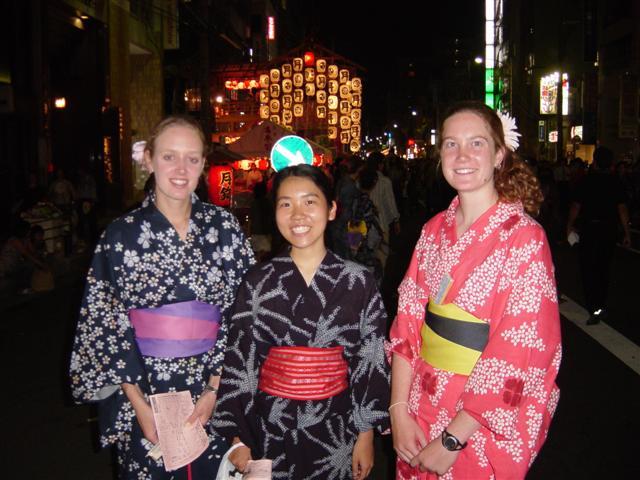
Since I fit into neither category a. nor b., I did the yukata style my own way: I made one. And of course, having spent a good amount of time making such a wonderful piece of clothing, I had to make sure I accessorized it correctly as well. I went all out. Here's what all the Japanese girls and I are wearing:
1. The Yukata: A summer kimono should have a summer pattern - flowers, fireworks, dragonflies. Mine is pink with white cherry blossoms.
2. Geta: Tradional style wooden flip flops. I had to buy the slightly more square-toed men's size because of my big feet.
3. Drawstring handbag: Again, flowers are good. It's better if it's not the same color as your yukata.
4. Floppy silk flower in your hair: Traditionally, there are decorated, dangly pins that one sticks in one's hair, but this year flowers are in.
5. Fan: Regardless of whether it's a folding fan or the one the man on the street is handing out, it should be stuck in your obi - big ones in the back, little ones in the front.
Wearing a yukata for the Gion Matsuri was a great experience. I learned to tie my own obi, and I was completely comfortable walking around in my geta. I didn't get as many stares as I expected, and I was glad about that too. Either the yukata made me blend in, or people in Kyoto are getting used to foreigners doing weird Japanese-like things. I went out two nights in a row, walking around with friends, looking at the floats, and eating festival food. I didn't go to the parade in the morning, and it's a good thing too. I watched a bit on TV, and the people lining the streets did not seem so comfortable packed in and sweating in 90 degree heat.
Anyway, the Gion Matsuri was fun. You can see some of my random pictures here. I tried to get some photos of cute little Japanese kids, because there is nothing cuter than a little kid in a yukata, but it was too dark. Oh well. Enjoy anyway.
Sunday, July 17, 2005
Thursday, July 14, 2005
Evening Out
I'm sure that not all Japanese Fulbright Alumni are higher-ups in major companies in Japan, but there are quite a few. And one of them took us out to dinner last night.
Dinner on Pontocho at one of the restaurants overlooking the river is just one of those things you always think you would like to do, but could never afford. Sadly, the rain lessened our viewing pleasure, but the food was good and the alcohol flowed freely.
The night continued with karaoke at another sort of place I had always wanted to check out: a hostess bar. Now, these sort of places are most everywhere in Japan. The more numerous ones are really just small bars run by one or two women whose job it is to keep you well beveraged and thoroughly entertained. We were both. In addition, our English and Japanese singing skills were a hit with the few other guests (who took pictures with us to capture the moment).
Overall, I am glad I was able to experience the Japanese salaryman's evening out.
Tuesday, July 12, 2005
Monday, July 11, 2005
Done. Almost.
I would have thought that with four years of experience in college I would have been completely over that so-nervous-I-can't-eat feeling right before giving a presentation. I mean, how many times have I partially prepared the night before and crammed the morning of and come out just fine?
Today was different. Today I was giving my year's work of research presentation in Japanese to some grad students, my advisor, and the professor who could provide me with an in to Japanese graduate school.
Bad Points:
-I was only 75% done when I went to bed last night.
-I had had minimal sleep the entire weekend.
-I spoke nothing but English the entire weekend.
-I lost my copy card.
-I was three minutes late to class.
-My Japanese was so bad that even I couldn't understand what I was saying. So I started over.
-In my haste, I forgot to change my "so I know what I'm talking about" headers into something more professional.
Good Points:
-They didn't laugh.
-I used up an entire hour with the presentation, so I only had to answer questions for 30 minutes.
-My advisor said he was impressed that I talked for one whole hour.
-I'm done.
So I'm celebrating tonight with hours and hours of JJ100, All-You-Can-Play Game Center, for free!
Sunday, July 10, 2005
We Are the Champions
The Champions of the 2005 Tajima Ultimate Tournament are the Kinki Trolls.
That would be my team. Yeah Kinki!
This weekend in the little mountain town of Tajima, Hyogo Prefecture, Japan the foreign ultimate players of Japan gathered for a tournament. The highlights:
1. There was no force middle to be seen anywhere.
2. Long hucks and tall guys who could catch.
3. American English, British English, Australian English. ENGLISH.
4. Barbeque with free flowing beer, and people who could drink a lot of it.
5. First game at 12 noon on Sunday.
6. Going 4-0. Winning the final 12-11.
7. Drinking sake from the trophy cup.
8. Team picture in a kinki pose.
9. Onsens.
10. Playing the best ultimate I have played (teams, spirit, competition) since I came to Japan.
Thursday, July 07, 2005
Taking "Belated" to the Limit
I opened the mailbox today to find a package...from myself.
Three months ago I sent a birthday present to my friend, Jill, in Egypt. It came back to me today. It had been opened, searched, repacked, and tied with a string and this really cool lead button thing that looks like it was hand-made somewhere by an unstudious apprentice.
The contents were all present and accounted for, although the chocolate had melted and reformed into a state beyond edibility. It's a shame that I already told Jill what she was supposed to have gotten, but now, instead of a surprise about what she's getting, she'll be surprised that she's getting anything at all!
Thanks to the combined efforts of the Egyptian and Japanese Postal Systems, my friend will have a wonderful belated birthday present.
Under Attack
My floor looks like a miniature battle field; ant carcasses dot the tatami.
It seems that as the infintry invades the first floor, the air units have been sent to my room.
I am doing all in my power - bleach, vinegar, peppermint, boric acid, insecticide, cockroach spray - to hold them at bay, but their numbers are overpowering.
All I can think about as I go to bed is:
"It is estimated that the average person consumes a pound of insects in their lifetime."
And I sleep on the floor.
Wednesday, July 06, 2005
The Cost of Being Environmentally Friendly
One thing that usually impresses people when they come to Japan is how orderly and on time everything is. I, too, am a big fan of predictable train and bus arrivals. But lately, I am not too happy about the schedule of my recycle truck.
I was told the garbage truck comes every Tuesday and Friday at 9am. I can safely put my garbage out at 10am and it still gets picked up.
I was told that the recycle truck comes every Wednesday at 8:30am. Every Wednesday for the past three weeks I have tried to recycle unsuccessfully. I go at 8:30am, and the truck has gone. I go at 8:20am, and the truck has gone. I went this morning at 8:15am, and the woman across the street says, "It just left."
If I put the recyclables out the night before, the neighborhood ladies give me evil glares. If I try in the morning, I inevitably fail. I'll try one more time next week, but if that doesn't work, I'm going to start taking my bottles and cans one by one to the convenience store where they have recycling bins that say "Not for household recyclables" sitting right outside.
Tuesday, July 05, 2005
Is there a fourth of July in Japan?
Of course there is. But it isn't accompanied by barbeques, fireworks, beer, and red, white, and blue t-shirts. When I got an invitation to the American Consulate General's Fourth of July Celebration, I thought I might get lucky enough to see an American flag shirt or tie adorning a beer drinking ex-pat. I was mistaken.
In a casual skirt and sandals, I was the least dressed up among the suits, cocktail dresses, and kimonos passing from the seared katsuo steaks to the "Salads of the World." It was either the clothes, the name tag, or the way I bee-lined for the food that kept other guests away while I took full advantage of such a generous offering of delicacies. Whatever the case, I dined in true American style by stuffing myself silly.
Apparently, the national anthem was played before I showed up fashionably late, but I was just in time for a jazz set and a tsugaru shamisen highlight. There were really only two things at this party which I could absolutely say were American.
1. Cold bottles of Sam Adams. Sadly, too few for such a thirsty crowd, but much appreciated by those of us who got our hands on a few bottles.
2. Pecan Pie. Japanese in size, but American in taste.
Hooray for another year of Independence for US.
Hope we can learn to use it more wisely this year than we did last.
Monday, July 04, 2005
Don't Have the Skills
A couple weeks ago I said that the rainy season had started. I was wrong. The rainy season is now. So far we've had four days of pouring down rain. There are no smiling sun faces on the weather forecast.
I don't mind the rain. What I don't like is getting wet. And when you rely on your bicycle for transportation, you get a lot of wet. I don't know how they do it, but every Japanese person riding a bike holding an umbrella is miraculously dry. I can ride with an umbrella too, but the only part of me that stays dry is my head. I either need more practice or money for the bus.
Friday, July 01, 2005
Sayonara Tomodachi!

The last of my visitors left this morning. My house seems too quiet and extrememly bare now. I had a great time while everyone was here, though.
Anna and Jeff and Sarah reminded me of how much fun we had back in the good old KCJS days. A Bar, purikura, shabu-shabu, fireworks by the river, wandering Shijo Karasuma...crazy good times.
Jill and Erik taught me that walking is good. Yes, there are famous things in Japan, and yes it is nice to see them, but just wandering around the neighborhoods at a leisurely pace is often better than rushing to see golden temples and such. We also learned that the Japanese think that walking farther than ten minutes is too far for walking. I don't know how many times they said, "You can't walk there," and twenty minutes later, we had walked there.
Thank you all for coming and visiting me and making this month exciting and happy! I will visit you all in the fall, I promise!!!
Wednesday, June 29, 2005
The Power of Hot Water
There's something about onsens that make all problems seem trivial. Just the prospect of a relaxing hour soaking in a steamy bath keeps me happy through traveling troubles. And so today, when I had no umbrella and the rain poured down on the shrines of Nikko, I joined the monkey statues and thought no evil. I was headed to an onsen. And when Jill accidentally threw away her rail pass and we had to go all the way back to find it, only to discover that someone had searched through the trash and returned it to the station for us, I was calm- I had just spent the afternoon at the onsen.
Something Fishy
Tsukiji is the biggest fish market in the world. There are lots of fish. The most famous are the tuna. Do you know how big a tuna fish is? It's not small.
We slept in, and by the time we got to the market at 6:30am the auction was over, but they were busy buzz sawing the frozen and cutting up the fresh tuna carcasses all over the place. We wandered around staring back at the fish eyes and learning the difference between ink squid and short fin squid.
I think that if I would have seen the fish market four years ago, back when I hated fish, I probably would have been disgusted. As I passed the chunks of tuna meat and beheaded yellowtails today, however, I found myself thinking,"It looks so delicious!" The more fish I saw, the hungrier I became. So, naturally, we stopped off at a nearby sushi restaurant for fresh breakfast.
Skin City
Tokyo is just the same as it was when I was here a couple weeks ago. The only difference is the heat and consequently the increase in scantily clad women. It seems that the foreigners have exerted more influence on fashion and social customs in Tokyo than in Kyoto. Their influx is apparent in every strapless dress and tube top. This style is far from taking over, but to compared to the elbow length gloves and floppy hats of Kyoto, it's a bit of a shock.
Sunday, June 26, 2005
Riding Off to Join the Circus
The Japanese love bicycles. Some Japanese love small-wheeled bicycles. There is only one advantage of the latter, in my eyes. You can fold them up and take them on the train with you. I've seen this twice.
Disadvantages I found out this morning, when I rode one for the first time. Firstly, put me a small wheeled bike and I look like I belong in the clown act of the Ringling Brothers Circus. Secondly, because those wheels are really small, you have to pedal really fast to go anywhere. I rode this bike from my house down to Dave's house, a six minute ride on a normal bike. It took me fifteen on Bozo's transportation. I ran back home in nine.
And so, in conclusion, the students I see riding these things around are either idiots, or they're trying to get more exersize. I vote the former.
Friday, June 24, 2005
Good Times
Some days I'm lucky. Yesterday was one of them.
-The rail pass lady didn't look at my passport.
-We were two minutes late, but the train was five minutes behind.
-A foreigner-loving business man bought us beers and snacks at the baseball game.
-The drunken college guys in front of us gave us the excess popcorn they bought from the cute vendor girl.
-Nomura got his 2000th hit in our presence.
-The Hiroshima Carp beat the Yakult Swallows 5-2.
Thursday, June 23, 2005
Traveling In Style
There are the cheap ways of traveling across the country, and then there's the Shinkansen(bullet train). But when you're carrying a Japan Rail Pass, the regular rules of travel don't apply. For a mere 250 dollars you can enjoy seven days ofunlimited speeding trains. Flash the card at the station guy and step on.
Technically, I'm not suppossed to have this pass since I hold a long term visa. But the ticket woman didn't look, and I didn't tell. And now my friends and I can prance across the country as the good tourists we pretend to be.
Sunday, June 19, 2005
Old and New Questions
My friends are here, and as is my duty and privilege, I am taking them around to all the good places in Japan. Their presence has made me look again at Japan through fresh eyes as I try to answer questions such as these:
Why is it impolite to blow your nose in public?
What is the meaning of the incense at temples?
Why does no one wear helmets when riding bicycles?
Are Japanese women all anorexic?
What is the difference between sushi and sashimi?
Do I dip it in this, or do I dip it in that?
How much does it cost to put up a torii at Fushimi Inari?
Why do you pay for hotel rooms by the person?
What's the difference between all the green teas?
Why do the toilets have sinks attached to the back?
What's with the women in welder visors?
Why do the entire schools go on field trips together?
Why are there so many different train lines in such a small area?
Why doesn't anyone steal the bike secured with a 100 yen lock?
How can 100 yen sushi be so good?
Why the crowds on the 1800 yen seats, when you can sit on the rocks for free?
Thursday, June 16, 2005
Welcome to Japan
As a rule, I don't like tourists in my country. I am generally a nice, helpful person, but when I see map reading, non-Japanese speaking, group traveling tourists on the streets of my city, I smirk and avoid. Why? I can't answer this specifically, but I believe it has something to do with the fact that most English speaking travelers feel that they can go anywhere and be just fine with their wonderful knowledge of English. I don't condone the absolute intrusion and interference into normal citizens' lives that pushy tourists bring.
This is my attitude.
However, I reserve the right to modify my attitude when my non-Japanese speaking friends come to visit. I will reconsider the points that make other foreigners odious to me. If they have a Japanese speaking guide, it's okay for them to be here. It they travel in groups of less than three, I won't rudely ring my bike bell at them to clear the sidewalk. If I hear them making a true attempt at mastering more than "please" and "thank you," I will possibly smile and not secretly despise them for their horrible accent.
Don't critisize me for this way of thinking. I am not really spiteful. But go live in a foreign country for a year, and you'll see what I mean. There are others that think the same way I do.
Monday, June 13, 2005
There Must Be Something Better
The most popular shows on Japanese television are panel shows where celebrities watch clips or do stunts and then everyone expresses their opinion. There are so many of these that they're running out of things to talk about. Case in point, a show I saw today:
A Japanese celebrity panel was commenting on a Korean celebrity panel show. They would watch the Korean clip and the Korean responses, and then talk about it. When that was over, they moved on to discuss American Reality TV clips. That's when I turned off the TV.
There are some people who refuse to watch Japanese TV because it is so ridiculously stupid, and there are those who love to watch Japanese TV because it is so ridiculously stupid. I waver back and forth. Today I am the former.
Saturday, June 11, 2005
Whatever Works
The man dressed as a woman screeched at the man dressed as a warrior. He rumbled back and advanced up the stage. Left foot slide, toe lift, pat as it comes down. Right foot slide, toe lift, pat.
I imagine that tabi socks have to be particularly clean and white for Noh performances since the feet have such an active role in the play. When a Japanese person describes Noh, they will always say, "The movements are so slow and deliberate, and they raise their toes when they walk. Like this.." And you'll get an example. The feet are probably what keep most people's attention as they try not to nod off.
I was mesmerized by the drum player's eyebrows. "Yoawoooh" Eyebrows up!donk! Eyebrows down "Yoh" !donk! Eyebrows wiggle "Yawh" !dink! "Yawh" !dink! Wiggle wiggle .
I imagine that tabi socks have to be particularly clean and white for Noh performances since the feet have such an active role in the play. When a Japanese person describes Noh, they will always say, "The movements are so slow and deliberate, and they raise their toes when they walk. Like this.." And you'll get an example. The feet are probably what keep most people's attention as they try not to nod off.
I was mesmerized by the drum player's eyebrows. "Yoawoooh" Eyebrows up
June Showers
When I said the other day that the rainy season was coming, I seriously didn't think it was going to arrive so soon. After pouring all night and all day, the weather settled down this evening to the infamous Kyoto summer swelter.
Kyoto is situated in a valley, a little pocket where all the hot air gathers still and heavy. Most people avoid this city during the summer not because it is hot, but because it is unbearably humid. I can't wait until the time comes once again when I will take one step outside and immediately be soaked in a combination of the water particles in the air and my own perspiration.
But for now I am sitting in my room trying to accustom my lungs to this extra strain and trying not to think of the bugs breeding in my tatami.
Friday, June 10, 2005
First Impressions Can Be Wrong
I started getting emails about my high school's five year reunion last week. So far, fourteen people have replied. This is probably not representative of our class of 165, but I would just like to point out the fact that:
2 are engaged
6 are married
2 have a child
2 are married to each other
12 live in the midwest (Indiana, Illinios, Ohio, Wisc.)
1 lives in California
1 lives in Japan
*This is in addition to the few I have seen on the facebook.com that are also married with kids.
When I graduated from this "smart school," I was sure that a good 50% of these people would be doing amazing things in the years to come. I'm not saying that what they're doing now (living in the midwest, getting married, and having babies) is a bad thing. It's just not what I pictured.
Wednesday, June 08, 2005
Centipedes on Steriods
- I woke up to the sound of dogs fighting. A few of the dozen housewives who walk their dogs in the morning must have started chatting and forgotten that the toy on the end of their string was alive.
- A centipede crossed my floor while I was studying. I dropped a full box of laundry detergent on it. I came back from my shower to find that the box had moved and there was no squished bug body underneath. I hope all insects in Japan are not this strong.
- The whole country was watching just minutes ago as Japan beat North Korea in the bid to the World Cup. You've gotta love the national unity that gets the game televised without commercials.
Tuesday, June 07, 2005
No Warning
I can't remember if this is how it was in Indiana or Boston, but in Japan, the seasons start suddenly. For example, three days ago I was wearing long sleeves and pants. Yesterday the temperature jumped to 28 C (don't ask what it is in F cause I don't know), and it's not going back down, they say.
Tsuyu, rainy season, will start the same way. A week or so from now, the sky will turn grey and the rain will pour down without warning. I'm debating whether a 100yen poncho will keep me dry enough. Maybe I'll spend the extra money for an umbrella holder for my bike.
Tsuyu, rainy season, will start the same way. A week or so from now, the sky will turn grey and the rain will pour down without warning. I'm debating whether a 100yen poncho will keep me dry enough. Maybe I'll spend the extra money for an umbrella holder for my bike.
Monday, June 06, 2005
It's that time again
Grass makes me happy. It makes me so happy that I will do ridiculous things just because it is present.
I went down to Osaka yesterday to play pick-up ultimate (it exists in Japan!!). We played on a moderately grassy field. I was ecstatic for the green. I was crazy about the lack of sand. I was blind to the small rocks and hard ground.
I dove. I skidded. I acquired a wound the size of a saucer on my thigh.
Does it hurt? Yes. Does it ooze? Yes. Am I sorry I did it? Absolutely not. Most teams in Japan, including mine, experience a lack of contact with the ground due to their sand/dirt fields. I had been missing that wonderful body wrenching impact. Now I feel that the Ultimate season has started once again.
As is said by the best old members of the O3P, "Pain heals. Guys dig scars. Glory is forever."
Sunday, June 05, 2005


Friday, June 03, 2005
Someone's Been Spying
I answered my door two minutes ago to find two Japanese Jehovah's Witnesses standing on my porch. I knew they would be coming around eventually, since a new Kingdom Hall was just built a few months ago down the street, but I wasn't expecting them this soon.
"A few fellow believers told me that there were some foreigners living in this house, so we wanted to come talk to you in English and share the positive attitude that God has given us."
I want to know who these "fellow believers" are and what they've been doing spying around my house. I want to know how they knew I was an English speaking foreigner. I want to know if there is a gossip network that talks about this house like a black spot on the perfection of the neighborhood.
How is it this easy to be singled out?
Wednesday, June 01, 2005
Tokyo, Part 4
Tokyo.
An unsuccessful search for a public bath (we remained smelly).
A Tour of the Diet (named after the German Parliment).
A talk by the longest serving Representative (from Aomori Pref.).
A free lunch of Subway sandwiches provided by the Fulbright Alumi Association (I ate 45cm).
A tour of the Supreme Court Building (hasn't been touched since the 70's).
A talk by a Supreme Court Justice (I apologize, sir, for falling asleep).
A nap on the grass of the Imperial Palace (the homeless guys know the best places to sleep).
A 630 yen dinner of Thai curry (things are cheaper under the train tracks).
A walk around Tokyo Station (too big for it's own good).
A night bus back to Kyoto (two seats to myself).
Kyoto.
Sendai, Part 3
The Japanese like to label and rank things. For example, there are "The Three Most Beautiful Spots in Japan." One of them is in Sendai. It is called Matsushima, which means "Pine Island(s)," and in this case, it is a bay filled with rugged piney islands. I can't agree that it is beautiful, though. Maybe a couple hundred years ago, yes. But not now when everything has been paved over and there are thousands of old people following their flag-waving tour guides.
Most places in Japan are famous for something. Sendai is famous for Cow Tongue. You can't walk ten steps without finding another restaurant that sells gyutan. So we had some for dinner, naturally. The place we went also served Ox Tails with your Cow Tongue. The tails were good, the tongue was not bad. And now I have eaten from one end of the cow to the other.
Most places in Japan are famous for something. Sendai is famous for Cow Tongue. You can't walk ten steps without finding another restaurant that sells gyutan. So we had some for dinner, naturally. The place we went also served Ox Tails with your Cow Tongue. The tails were good, the tongue was not bad. And now I have eaten from one end of the cow to the other.
Winding Down, Part 2
We were woken by day hikers pausing for a break at our hut. We ate the last of our food, cleaned up, packed, and hiked down the mountain.
As most trips in Japan often go, we ended our hike at an onsen. We decided to go back to the one onsen that was nice to us the night before as a reward for their kindness. That was the best idea ever. It was the nicest onsen I have ever been to. And, it was my first experience in a coed onsen. The coed outdoor baths had a wonderful view of a waterfall which we admired while trying to keep our hand towels covering the appropriate parts. It was pretty funny.
After cleaning ourselves thoroughly, we headed down for lunch overlooking Lake Tazawako, the deepest lake in Japan. From there we drove to Sendai. I drove on the highway. There were no speed limit signs, so I went 130. Kmph.
The Hiking, Part 1
As usual, things started out uneventfully. The ferry ride was long, but calm. Getting the rent-a-car, buying groceries, picking up our fourth member, and driving to the Hachimantai National Park was unnmarred by complications. The first hiccup was a combination of two factors which were solved together. Firstly, we forgot to fill up our water bottles. Secondly, the road to the trailhead was blocked off. However, knocking on the door of a nearby house, we found people nice enough to let us borrow some water and tell us these important things:
1. the chain blocking the road could be moved, and we probably wouldn't get in trouble for it
2. there is a nice hut at the top of the mountain
3. the top of the mountains are still covered with snow
The first two were well noted, the third went in one ear and out the other.
The actual hiking on this first day was fairly easy. The trailhead started above the tree line, and our hike to the mountain hut was a gradually ascending winding path around to the other side of the mountain. We passed sulfur hills, poked at a dormant toad, avoided sliding down snow-covered inclines, and tread on porous stone that made up the volcanic mountains.
The hut was barely visible across a shallow lake as we and the fog arrived simultaneously at a small plateau near the top of the "Woman's Eye" Mountain. With only minimal trouble from the kerosene stove, we prepared our spaghetti dinner and s'mores for dessert. The day ended early after a few card games when the cold became unbearable and we all retreated to our warm sleeping bags.
Because our car was parked in one spot, the next day's hike was to be a loop, ending us back at the same hut for another night. We left our heavy packs and started our eight hour hike as the sun burned away the fog. We climbed up and down mountains and ridges noting the changing color of the soil: red, black, orange, yellow, brown. Our goal was "Breast/Nipple" Mountain at an elevation near 1600 meters. Other than the pause to eat lunch under an overhang when it started to rain, we reached the summit with no problems. From there, we started our descent to a valley filled with onsen (hot springs) and their accompanying resorts. We even found a natural pool along the way, but it was so incredibly hot that our little toes could only handle it for three seconds at a time.
It was four p.m when we reached the onsen valley. Consulting the map, we determined that if we went just a little faster, we could make it back to the hut just as the sun was setting. So off we went. Over the ski slopes and through the forest we went. Our first trouble came when we reached a beech grove carpeted with snow. The trail was invisible and the trees were not marked. We painstakingly followed one set of footprints coming from the opposite direction.
Our second problem occured when the trail ended halfway up the mountain in the midst of snow covered slopes. Here and there dense islands of dwarf bamboo spanned across the white. An hour later we had scrambled, slid, and pulled our way to meters from the peak in the direction toward which we were sure the trail went. But the brush was unrelenting and the sun was setting. It was cold, and we only had one headlamp between the four of us. It was tough to give up when we knew that our car was a mere thirty minutes on the other side of the mountain, but it was either turn back or be those foreigners who had to get rescued from a mountain. We slid down the snowy slopes like children who lost their sleds.
Two and a half hours later, after retracing our footprints through the beech forest, manuvering through roots and streams with only one light, we emerged at the ski slopes. We paused for an astronomy lesson by our resident astronomer. The stars were absolutely gorgeous - innumerable, bright, and enveloping. This was the last good thing of the evening.
We were rejected by three onsens. No room at the resorts. One even turned off the lights and locked the door when we left.
The nice one let us use their pay phone to call a cab. He drove us back to our car, bearing with us while we unchained the "do not pass" sign from the middle of the road for him.
It was now midnight. We drove to a convenience store for dinner. We drove around some more looking for another hotel to stay at.
We were rejected by three more.
We drove back to the parking lot where we tried to sleep in a cold, cramped car.
The sky became light at 3:15am, and the sun rose around 3:45am. We were hiking back to the hut by 4:15am.
Daily totals:
Distance: 16 miles
Hiking time: approx. 11 hours
Hours of sleep: 2-3hrs. (okay, we slept again at the hut, but...)
Tuesday, May 31, 2005
Teaser
Every time I go on major hiking trips in Japan something goes wrong and a fiasco unfolds. Stand by for the upcoming story, "One Headlight On the Invisible Trail."
Friday, May 27, 2005
Empty Spaces
There are places in Japan known for being rural, and Akita Prefecture is one of them. Being a midwest girl, when I think rural I think sprawling farmland. And in my mind there can't be a country that doesn't have a little of that hidden away somewhere. This trip, however, is finally convincing me that this is impossible in Japan. Everywhere you go there will be either cities or mountains. The fields are squeezed in between railroad tracks and foothills like misplaced puzzle pieces. Even in the most rural places, the landscape is crowded.
Thursday, May 26, 2005
So much water
Last time I was on a ferry in Japan, I was heading back from a week of hiking in Kyushu. This time I'm going 19 hours north to Akita for a week long hike/tour of the northern part of the main island.
It's really nothing exciting being on a boat that long. I planned my day around the hours that the bath (that's basically a hot tub in Japan, even on a boat) were open.
Monday, May 23, 2005
The Letter of the Law
I ride up to the corner just as the crosswalk light turns red. I'm standing behind two high school aged boys in altered school uniforms talking with mafia-I'm-really-cool accents.
Saggy Pants: Ah man, we should have freakin crossed.
Spikey Hair: I tried, yo, but that hot chick almost hit me with her bike.
Saggy Pants: Alright, next time there aren't any cars, I'm going.
Spikey Hair: Hold on, dude! There are cops right there.
Saggy Pants: (looking over his shoulder) Naw, they can't see us.
Spikey Hair: They can so. Lookin right through the window at us.
Saggy Pants: Well crap.
Spikey Hair: I guess it ain't worth it.
Saggy Pants: No, we can't risk it.
And they wait patiently until the light turns green.
Sunday, May 22, 2005
Fashion Police: the newest Japanese ministry
"Is a Salaryman Without a Suit Like Sushi Without the Rice?" (NYTimes)
Do you want to stop global warming? Have an interest in fashion?
Starting in June the Japanese government introduces "Cool Biz," the new look for salarymen and the first step toward reducing green house emissions in Japan.
Prime Minister Koizumi says, "The government will take the lead in prevention of global warming," he said. "From this summer, government is planning to start no necktie, no jacket."
The salarymen are not happy.
High Class to No Class
I had an hour and a half before my bus left. So I continued my "I am sophistacted" day and sat down at one of the upscale restaurants in the Tokyo Station area for a little wine and dessert. I dined on a exquisite apricot tart and a glass of the recommended white wine while enjoying the spring evening on the patio.
And then I returned to normalcy. Or extreme boredom. I spent the next hour exploring one of the nearby "restaurants and shopping" buildings. Riding the escalator to the seven floor, I happened upon a bathroom. And because I am a connesouir of the best sort of places to find good bathrooms (department stores are the best so far), I went in. Evaluation: clean, but nothing special. However, they had western style toilets. By default, this means there was the little options bar on the side. I had never used any of the options. So I did. I pushed all the buttons.
-Flushing Sound
-Spray
-Bidet
-Dry
-Powerful Deoderizer
-Stop
I even changed the water temperature. I could have changed the seat temperature too, but my bottom was toasty at the current setting.
And so now I know. I suggest that if you travel in Japan you should try these buttons. And even if you don't have fun playing with the options, you at least walk out with a clean butt.
Lifestyles of the wannabe rich and famous
I took a little trip to Tokyo yesterday to see an opera.
Doesn't that sound rich and sophisticated? I thought it just sounded crazy, but a few of my Japanese friends said it had a very oshare (oh shah ray: similar to bling-bling, or fancy) ring to it.
Thanks to connections from Boston, I was invited to watch the New York City Opera Company's production of Madama Butterfly as a guest of the company. They are on a mini tour in Japan for the Aichi Exhibition, peforming Madama Butterfly and Little Women in Tokyo and Nagoya. My friend's father is an employee (the man in charge of all the people who don't sing) and he graciously allowed me and my friend to come see the Dress Rehearsal, and afterwards, to meander back stage. We got to meet the adorable little boy who played Sorrow, Butterfly's son, and we snuck a look at the makeup-coated tenor who, like most tenors, was finicky and didn't sing full voice.
The production was great. The set was very modern; there was nothing more than huge Japanese style doors, some stairs, and a kimono rack. The music was great. However, thanks to a friend who is studying the use of Eastern music influence on Western music and my own experience in Japan, I was looking out for "mistakes." Here's my list:
-The monk was dressed as an oni (demon), complete with the crown and long hair. He was accompanied by cymbals with a Chinese flair.
-The obis on the kimonos all matched. This is not how it is done.
-There were several times when the servant was praying to the ancestors, but "the ancestors" were little red Chinese warrior statues. What?! And she would call out "Izanami, Izanagi!" which are the names of the two mythological figures who created the Japanese islands, but are never invoked in personal worship.
-The suitor was wearing a Chinese wrobe, complete with Chinese style mustache and beard. He was also accompanied by obviously Chinese sounding music.
Really, Puccini probably didn't know any better, and you can't blame the Americans too much for having no idea about Japanese customs. Other than these little points, the music was great and it was wonderful to be able to learn about the behind the scenes stuff of an opera. Like, did you know that most of the actors don't set foot on the set until a few days before the show?
So, thank you to Mr. my friend's dad for the opportunity to see this production, and for paying for dinner afterwards. We really appreciated it.
Friday, May 20, 2005

Place Your Bets
Everyone says it's a small world. Here we say it's a smaller world when you're a foreigner in Japan. Today I tell you that the world has shrunk to the size of a peanut.
I was shopping this afternoon when two foreign girls joined me at the rack of bad English t-shirts. A few minutes later a Japanese woman came up to them and started speaking in English. I glanced over and almost died. Holy crap, it was my high school Japanese teacher!
Kishi-sensei had brought fifteen Academy students on a ten day tour of Japan for their May Term. They were in Kyoto for two days, and shopping in Teramachi for one hour, and I ran in to them. Seriously, somebody calculate the probability. Of course, I was invited to introduce myself to the group and tell them what I have been doing for the past five years since graduating. Looking over the bunch of them, I remembered how dorky Academy kids are. I was reminded of the stupidity of youth that would make two of them buy Japanese swords and one the Zen "stick of compassion." I was incredibly envious that they got such a good May term option.
At any rate, my day was made by this incredible happening. And thanks to the magic of the Japanese cell phone, I have pictures to prove it.
Fresh fish, Fried chicken
How many people think that sushi is the staple of the Japanese diet? How many people think that Japanese food is simple and healthy? You are all wrong. While the main Japanese food served in foreign countries does happen to be sushi or noodles, there are a whole bunch of other wonderful things to eat in Japan. And most of them are fried.
Walk into a grocery store, and head to the back corner. You will find a wonderful selection of prepared foods, kind of like a deli. However, 75% of them will be fried. Croquettes, tenderloins, fried chicken, fried tofu, tempura...
Are you surprised? Did you not realize that there are so many fried foods in Japan that you could eat a different one every day for at least a month? The amazing thing is despite the massive intakes of oil, high cholestoral and heart disease are not a big problem here. Perhaps it is the popularity of tofu or sesame seeds (both having lately been discovered as the best foods ever, health wise), or perhaps it is because the image of insanely skinny people is so ingrained that you are hard put to find a college student who doesn't count their calories.
Either way, while the Japanese can manage their fried food ingestion, I am slightly worried for my caucasian heart. I cannot resist the croquettes. Or the tenderloins. Or the fried tofu. In fact, I just bought all three for lunch.
Thursday, May 19, 2005
Perspectives
The reason I haven't posted anything for the past couple of days is that nothing interesting has been happening. Normal days filled with homework, TV, eating, sleeping, and riding my bike. Yes, there was a small festival yesterday, and yes, I paid large amounts of money for a train ticket today, but these are really not exciting to me.
And then I realized as I was walking down the street that the things I see here as totally normal probably look completely strange to visitors. I have been trying to think lately where I am going to take my first-time-to-Japan visiting friends when they come, and it is so difficult. What was it like when I first came here almost three years ago? What did I think was completely unbelievable, incredibly weird, and just downright wrong? I have forgotten. I have integrated myself into the society. I have grown immune to the idea of crazy hairstyles, Japanese drivers, bike traffic, and bowing. Japan is not a scary country, Japan is a second home.
And then I realized as I was walking down the street that the things I see here as totally normal probably look completely strange to visitors. I have been trying to think lately where I am going to take my first-time-to-Japan visiting friends when they come, and it is so difficult. What was it like when I first came here almost three years ago? What did I think was completely unbelievable, incredibly weird, and just downright wrong? I have forgotten. I have integrated myself into the society. I have grown immune to the idea of crazy hairstyles, Japanese drivers, bike traffic, and bowing. Japan is not a scary country, Japan is a second home.
Monday, May 16, 2005
Who knew it would actually be good for something?
When I was in grade school I, like a good percentage of Indiana children, participated in 4-H. I don't remember pledging "my Head to clearer thinking, my Heart to greater loyalty, my Hands to larger service, and my Health to better living," but I do remember baking cookies, organizing collections, wrapping gifts, and sewing skirts. I especially remember the sewing. It's not that I was good at it. It was that my grandmother was good at it, and I spent hours at her house laying out the pattern, hemming, and stitching up the ugliest skirt I have ever seen. I won Honorable Mention for it.
That project workbook and the hours with my grandma's sewing machine paid off today as I began my first sewing project since 7th grade - I'm making a yukata, a summer kimono. It was my friend Mayo's idea. She's helping my friend Katie and I make yukata for the Gion Matsuri so that we too can join in on the traditional feeling of an old Kyoto festival. My cloth is a light red sprinkled with small white sakura and accented by some other maroon flower. I think it's going to look great. Now, if only I could find geta big enough to fit my enormous feet...
That project workbook and the hours with my grandma's sewing machine paid off today as I began my first sewing project since 7th grade - I'm making a yukata, a summer kimono. It was my friend Mayo's idea. She's helping my friend Katie and I make yukata for the Gion Matsuri so that we too can join in on the traditional feeling of an old Kyoto festival. My cloth is a light red sprinkled with small white sakura and accented by some other maroon flower. I think it's going to look great. Now, if only I could find geta big enough to fit my enormous feet...
Sunday, May 15, 2005
Accomplishment
There's something about drunk Japanese guys practicing their English that makes me smile.
Friday, May 13, 2005
The Truth Comes Out
Today was one of those days that made me wonder what I have been doing with the last five years of my life. Specifically, I wonder what happened to my brain. Back in the day I could memorize words and remember them for more than three days. I could read something and fully comprehend and synthesize it with other information. Not any more, it seems. I have been studying the belief in vengeful spirits in premodern Japan for a little over two years now. And yet, when the topic came up in class today and no one knew anything about it, I could barely state the basics coherently. Is it because I haven't learned anything? No, I think not. I believe it is because I have lost the ability to retain information. The words I read in Japanese make sense as I read them, but I can in no way repeat those words to a curious audience. I can't even tell you the word for "political victim," which is probably the most important concept in this research.
And so, today I fully embarrassed myself and exposed the truth about my learning ablilities. That is, I have none. That I am decently good at pretending I am smart is evident in my receipt of the Fulbright, but I couldn't fool the graduate school admissions offices or people who know what they're talking about. From now on I will probably just be that foreign girl who sits in class pretending like she understands what's going on.
And so, today I fully embarrassed myself and exposed the truth about my learning ablilities. That is, I have none. That I am decently good at pretending I am smart is evident in my receipt of the Fulbright, but I couldn't fool the graduate school admissions offices or people who know what they're talking about. From now on I will probably just be that foreign girl who sits in class pretending like she understands what's going on.
Thursday, May 12, 2005
There are no noise pollution laws in Japan
Every morning at 8am the "we collect your paper, cardboard, and old newspapers" truck comes around. Every morning it drives back and forth, up and down the winding streets of my neighborhood for hours. How do I know? Because it plays a song. Thirty seconds of a whistling tune, a chorus of "give us your paper!" and a woman politely introducing this extremely convenient service. Thirty seconds repeated for two hours. The dogs bark, I cry, and it never stops. Not once have I ever seen (or heard) it pause.
I have learned to deal with this every morning, but it is now 4:50pm and I hear it just down the street. If it passes my house someone had better restrain me, because if a brick thrown to knock out that speaker is the only thing that restores to me my peaceful afternoon, then so be it.
I have learned to deal with this every morning, but it is now 4:50pm and I hear it just down the street. If it passes my house someone had better restrain me, because if a brick thrown to knock out that speaker is the only thing that restores to me my peaceful afternoon, then so be it.
Double Take
I'm riding my bike down the street in the rain.
I pass a KFC. A woman is standing outside yelling at a man in a cream-colored suit.
Turning the corner, I almost run over a small child and blind her mother with my umbrella.
I readjust my rain parasol to try to provide maximum coverage of my legs while keeping my backpack less than soaked. I give up on dry knees.
My mind wanders back to the Kentucky Fried Chicken scene I had just witnessed.
The woman was standing outside shouting into her cellphone while staring exasperatedly at a full size plastic statue of the Colonel.
I should have known. Who else besides the Colonel wears a cream colored suit?
Wednesday, May 11, 2005
Just testing
Blogger recognizes that this computer at school is Japanese, and therefore puts all my menus, etc, in Japanese. I'm wondering if I can post in Japanese, then. Here's a try.
今日の日本語の単語: TODAY'S JAPANESE VOCAB
こんにちは - konnichiwa = hello
おはいようございます - ohaiyo gozaimasu = good morning
ありがとうございます - arigato gozaimasu = thank you
すみません - sumimasen = excuse me
If you can't see the characters, go to View, Encoding, Japanese. Unicode might work too.
今日の日本語の単語: TODAY'S JAPANESE VOCAB
こんにちは - konnichiwa = hello
おはいようございます - ohaiyo gozaimasu = good morning
ありがとうございます - arigato gozaimasu = thank you
すみません - sumimasen = excuse me
If you can't see the characters, go to View, Encoding, Japanese. Unicode might work too.
Self-Imposed Segregation
I was counting down the minutes to the end of my class today, when I realized something - the girls and boys were seated on opposite sides of the room. There was no intermingling. Even the teacher was seated on the boys' side. I remembered a friend of mine saying that the same thing happened in all her larger classes here. It was the first time for me, but I have to say that I am not surprised. The more I talk to Japanese girls the more I realize that there is very little interaction between the sexes in the everyday life of a college student. The girls are afraid of not being attractive enough, and the boys are afraid they'll say something stupid, so no one talks. Hence, we have the popularity of group blind dates and drinking parties. Thank goodness for alcohol to break down the barriers, or the population in this country would be shrinking faster than it already is.
Tuesday, May 10, 2005
The Truth Hurts
It's a sad fact, but the best matcha (green tea) dessert in Japan is the Matcha Cream Frappuccino at Starbuck's.
Sunday, May 08, 2005
Steam ships and tea cups
I spent the day with my advisor today, a four foot tall Japanese grandma whose expertise in Japanese history is hard put to be matched by anyone. We were supposed to get together to discuss my research and how things were going. But as usual, she talked about something and something else, and another thing, and we said maybe two sentences about my research. This is fine with me, because 1. her research doesn't exactly match mine, 2. she has so many random interesting facts in her head.
For example, there was a monk name Kisen who lived on a mountain in Uji, and his name became associated with the tea from that area. When the Commador Perry opened the ports of Japan after the period of Isolation, he came on steam ships, called "kisen" in Japanese. There was a phrase, then about "kisenjo" or the "steam rising." And so there became a way of drinking tea that was a metaphor for the ships coming in to the port. Something to do with 4 ships, and 4 cups, and letting the steam rise. Nifty, eh?
For example, there was a monk name Kisen who lived on a mountain in Uji, and his name became associated with the tea from that area. When the Commador Perry opened the ports of Japan after the period of Isolation, he came on steam ships, called "kisen" in Japanese. There was a phrase, then about "kisenjo" or the "steam rising." And so there became a way of drinking tea that was a metaphor for the ships coming in to the port. Something to do with 4 ships, and 4 cups, and letting the steam rise. Nifty, eh?
A Bit Too Much Reality
The US has too much reality TV. Japan has too many reality video and arcade games. I went to my favorite "All-You-Can-Play" game center last night for bowling with my friends, but afterwards we stayed and learned how to dance, fish, play the drums, drive a train, ride a horse, play shamisen, box, swordfight, drive a bulldozer, skateboard, snowboard, play the maracas, ride a bike, hang glide, play the tambarin, play the guitar, play ping pong, shoot guns, play golf, and my favorite, walk a dog. All without leaving the comfort of our own video screen.
Friday, May 06, 2005
At long last
Tuesday, May 03, 2005
Raise Your Toe
Japanese traditional theatre is what most foreigners* would call boring. The form most often described in this way in Noh. Noh is known for it's repetitive music, slow and overly exaggerated movement, and simplicity (almost non-existance) of plot. To make matters worse, it is most often not performed individually, but as a set of three or four plays presented all afternoon. Luckily, some time ago, the Japanese realized that even the most enthusiastic fan needs a break from slow, seriousness. Hence, there is Kyogen. Kyogen is a form of Noh - the same style of music, the same bright costumes, and similar exaggerated dance. However, it also incorporates the comedic, and sometimes the hilarious. These satirical glimpses of Japanese religion, old court custums, and lifestyle are often inserted between the Noh plays to break up the monotony of the afternoon.
And sometimes, they are performed just by themselves. Like the most famous of kyogen styles, Mibu Kyogen, performed once a year at Mibudera Temple in Kyoto. Mibudera is famous for a lot of things, and this is just one of them. Its kyogen is particularly interesting because it has no words. None. Five one hour long plays done completely in pantomime with accompanying flute and drums, and the occasional foot stomp. And despite the lack of words and close resemblence to Noh drama, these plays are good. For example, the one that I particularly liked was about a bet between the Bodhisattva Jizo and the King of the Underworld, Yama. Jizo bet that one of his protectees, a hungry ghost, could beat one of Yama's little demon underlings in a sumo match. What followed was a hilarious stomping battle of quivering ghosts and fist-shaking demons. Who knew that wordless Noh could be so entertaining? Of course, part of the fun was just trying to figure out what the finger pointing, gesturing, and foot stomping really meant.
*Lots of Japanese find it really boring too. I don't mind it so much, but I know plenty of people who won't go again unless their life depends on it.
Sunday, May 01, 2005

Golden Week
Friday was the start of what is called Golden Week in Japan, a week of four national holidays, and consequently, one of the busiest travel times of the year. I was curious about what the holidays actually were, so I looked them up. Here's what I found (courtesy of www.japan-guide.com):
Apr. 29 : Midori no Hi
I used to think this was just Green Day, as a direct translation would go. But actually, it is Greenery Day. It used to be the birthday of the Showa emperor, who died in the year 1989. After his death, it was turned into a day for environment and nature, since the emperor loved plants and nature. Starting in 2007, the day will be renamed Showa Day, and Midori no Hi will be moved to May 4th.
May 3: Kenpo Kinenbi (Constitution Day)
On this day in 1947, the new postwar constitution was put into effect.
May 4: Kokumin no Kyujitsu ("Between Day")
I think the US should do something like this. According to Japanese law, a day which falls between two national holidays is also declared a national holiday, unless the "between day" is a Sunday, in which case it will be just a regular Sunday. From 2007, Greenery Day, currently celebrated on April 29, will be moved to May 4.
May 5: Kodomo no Hi (Children's Day)
The Boy's Festival (Tango no Sekku) is celebrated on this day. Families pray for the health and future success of their sons by hanging up carp streamers and displaying samurai dolls, both symbolizing strength, power and success in life.
Subscribe to:
Posts (Atom)